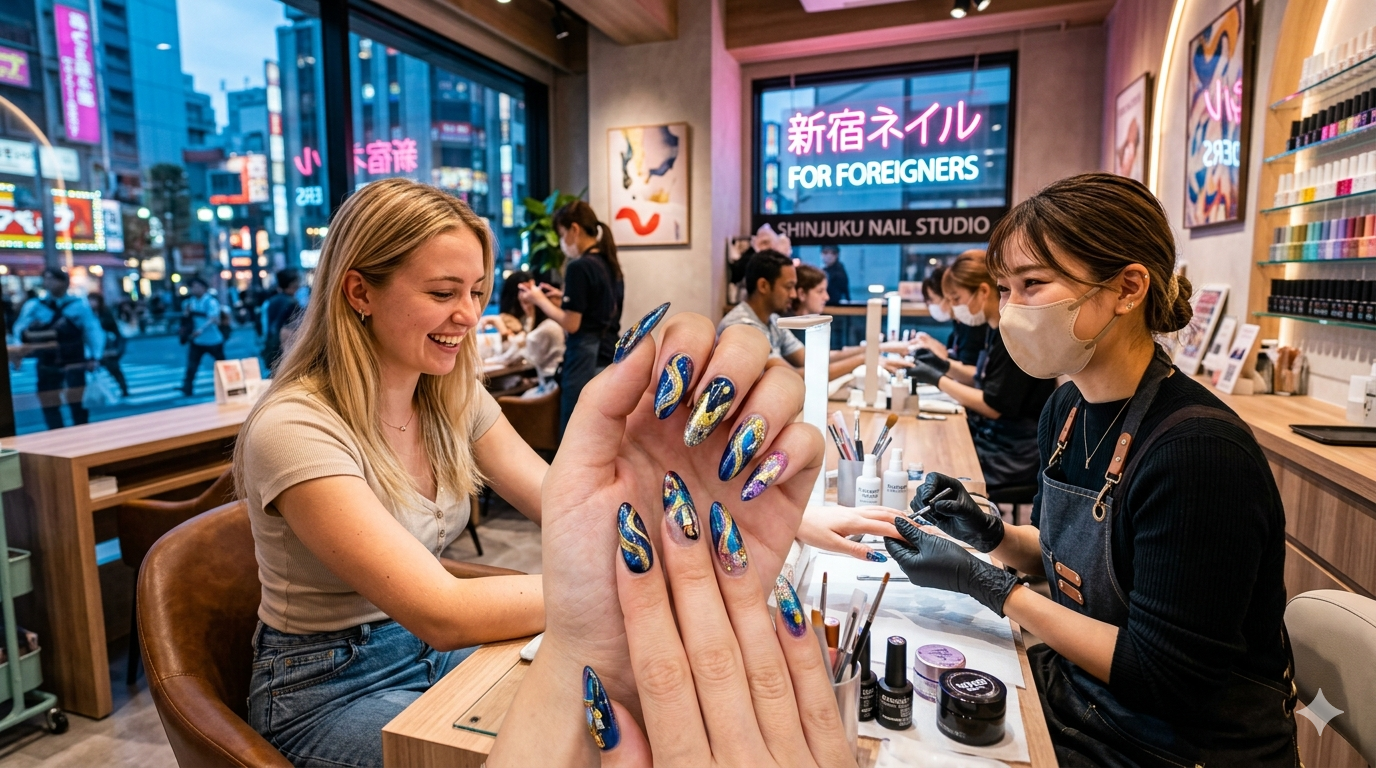
How to find a nail salon in Shinjuku that truly understands what foreigners need — English-friendly service, sculpt nails, gel, and over-the-top designs other salons refuse. Plus, the insider knowledge to make sure your nails last up to 8 weeks and look exactly the way you imagined.
Nail Salon in Shinjuku for Foreigners: Sculpt, Gel & Dramatic Designs Done Right
You finally found the perfect nail design online. Maybe it’s a set of long sculpted acrylics with 3D flowers and rhinestones. Maybe it’s that gyaru-inspired ombre with chrome powder and layered nail art that would turn heads anywhere in Tokyo.
You walk into a salon. You show them the photo.
And they say: “Sorry, we can’t do that.”
Or worse — they try, and it comes out nothing like you pictured. The nails lift after two weeks. The design is flat, the rhinestones fall off, and you’re back to square one.
If you’re a foreigner living in or visiting Shinjuku, finding a nail salon that can handle complex, dramatic nail designs — and actually communicate with you about what you want — is genuinely hard.
This guide gives you the full picture: what to look for, what questions to ask, what techniques actually work for long-lasting dramatic nails, and where to go in Shinjuku when you want nails that make a statement.
Why Foreigners Struggle to Find the Right Nail Salon in Shinjuku
Shinjuku has hundreds of nail salons. So why is it so hard to find the right one?
The answer isn’t just about language. It comes down to three structural problems that almost every foreigner runs into:
1. Most Salons Are Designed for “Safe” Results
The majority of nail salons in Japan — even in Shinjuku — are built around efficiency and low complaint rates. That means they specialize in clean, simple, trendy-but-not-too-extreme designs. Short to medium length. Gel only. No extensions, no sculpting, no 3D art.
If your vision is a 7mm square tip with embedded crystals and hand-painted anime characters, many salons will politely decline. Not because they’re being rude — but because they genuinely don’t have the trained technicians or the materials to execute it safely.
2. Language Barriers Go Both Ways
Even if a salon has a few English words on their menu, that doesn’t mean they can have a real consultation with you about nail shape, length, design complexity, or aftercare. And from the salon’s side, explaining why a certain technique won’t work on your natural nail type — or why a specific design requires sculpting rather than gel — is incredibly difficult without shared language.
The result: you get what they think you want, not what you actually wanted.
3. Sculpt Nails and Dramatic Designs Are a Specialty
Sculpt nails — whether chip sculpt or acrylic sculpt — require a completely different skill set than standard gel manicures. A technician who’s excellent at gel polish may have zero training in sculpting, length extension, or working with hard gel overlays.
In Japan, many salons quietly avoid advertising that they can’t do sculpt work. Foreigners, who often come in specifically requesting sculpted extensions, end up in a consultation that goes nowhere — or worse, get a rushed attempt that damages their natural nails.
Never let a salon attempt sculpt or extension work if they hesitate when you ask whether they specialize in it. An untrained technician performing sculpt nails can cause nail damage, infections, or severe lifting within days. Always ask directly: “Do you specialize in sculpt nails?”
Sculpt Nails vs. Gel Nails: What’s the Difference and Which Do You Need?
Before you book any salon in Shinjuku, it’s worth understanding the core techniques — because the answer to “which salon should I go to” depends entirely on what you actually want on your nails.
Gel Nails (ジェルネイル)
Standard gel nails use a semi-flexible gel product that’s cured under a UV or LED lamp. They’re applied directly to your natural nail. Most salons in Japan offer this.
- Best for: Short to medium length, relatively simple designs
- Typical durability: 3–4 weeks
- Removal: Requires soaking in acetone or gentle filing
- Limitation: Can’t add significant length or create 3D structural elements
Chip Sculpt (チップスカルプ) — The Main Technique at BARON
Chip sculpt is a hybrid technique that combines the best of extensions and gel. A nail tip (plastic or pre-formed gel tip) is bonded to the natural nail, then coated with hard gel to add structural strength, length, and a sculpted shape.
- Best for: Long nails, dramatic shapes (coffin, almond, stiletto, super-long), complex 3D designs
- Typical durability: Up to 8 weeks with proper aftercare
- Key advantage: No acrylic smell, less risk of over-filing, smoother finish than traditional acrylic sculpt
- Who it’s for: Anyone who wants nail length and structure without going full acrylic
Acrylic Sculpt (アクリルスカルプ / フォームスカルプ)
Traditional acrylic sculpt uses a powder-and-liquid monomer system applied over a nail form to build length and shape from scratch. It’s the technique most people associate with “fake nails.”
- Best for: Maximum structural strength, extreme length, sharp stiletto shapes
- Typical durability: 3–5 weeks before fill-in recommended
- Trade-off: Stronger chemical smell, requires experienced application to avoid damage
If you want long, dramatic nails without acrylic smell → Chip Sculpt
If you want extreme length and maximum hardness → Acrylic Sculpt
If you want natural length with art and color → Gel Nails
💅 By the way — at BARON, chip sculpt is our core specialty.
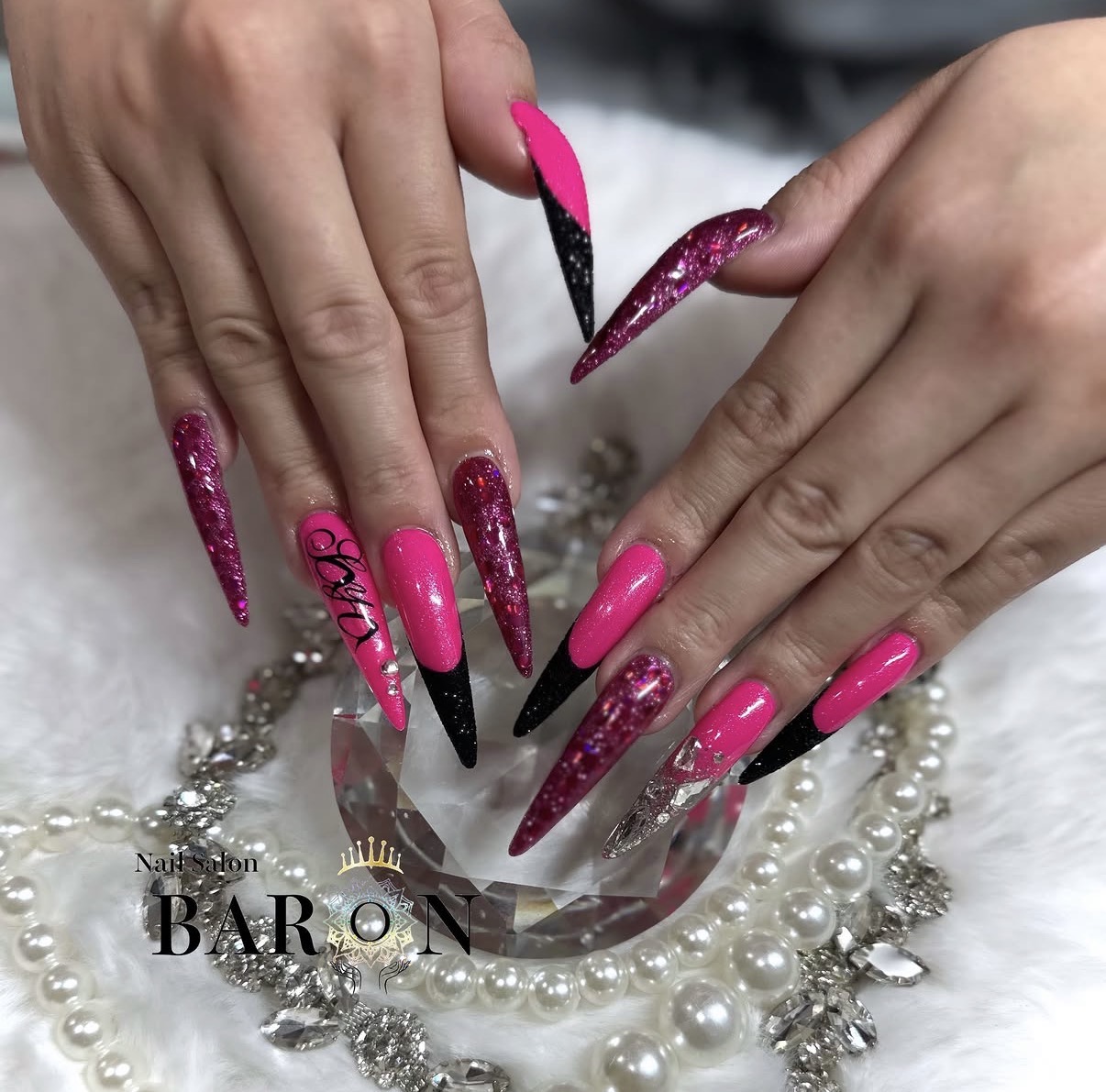
Our technicians are trained extensively in chip sculpt technique — the hard gel coating process that delivers up to 8 weeks of wear without the acrylic smell. We also offer acrylic sculpt for clients who want that extra structural intensity. During your consultation, we’ll recommend the right technique based on your natural nail condition and your design goals.
What Makes a Nail Salon Truly “Foreigner-Friendly” in Shinjuku?
The phrase “foreigner-friendly” gets used loosely in Tokyo. Here’s what it actually needs to mean if you want a great nail experience:
Real Communication, Not Just English Menus
An English menu is a start, but it’s not enough. A genuinely foreigner-friendly nail salon should be able to:
- Understand a design photo you show them and give honest feedback on feasibility
- Explain why a certain technique is or isn’t right for your nail condition
- Discuss length, shape, and design in enough detail that you leave with what you wanted
- Communicate aftercare instructions clearly so your nails actually last
If a salon can’t do this — in English, or through clear visual communication — you’re at risk of a result that disappoints.
Willingness to Take On Complex Requests
Many foreigners come to Japanese nail salons specifically because Japanese nail art is world-renowned for its precision and creativity. Gyaru nails, otaku/anime-inspired designs, 3D nail art, super-long coffin nails — these aren’t fringe requests. They’re exactly what people are coming to Japan to experience.
A foreigner-friendly salon should embrace those requests, not shy away from them.
Private Rooms or Thoughtful Space Design
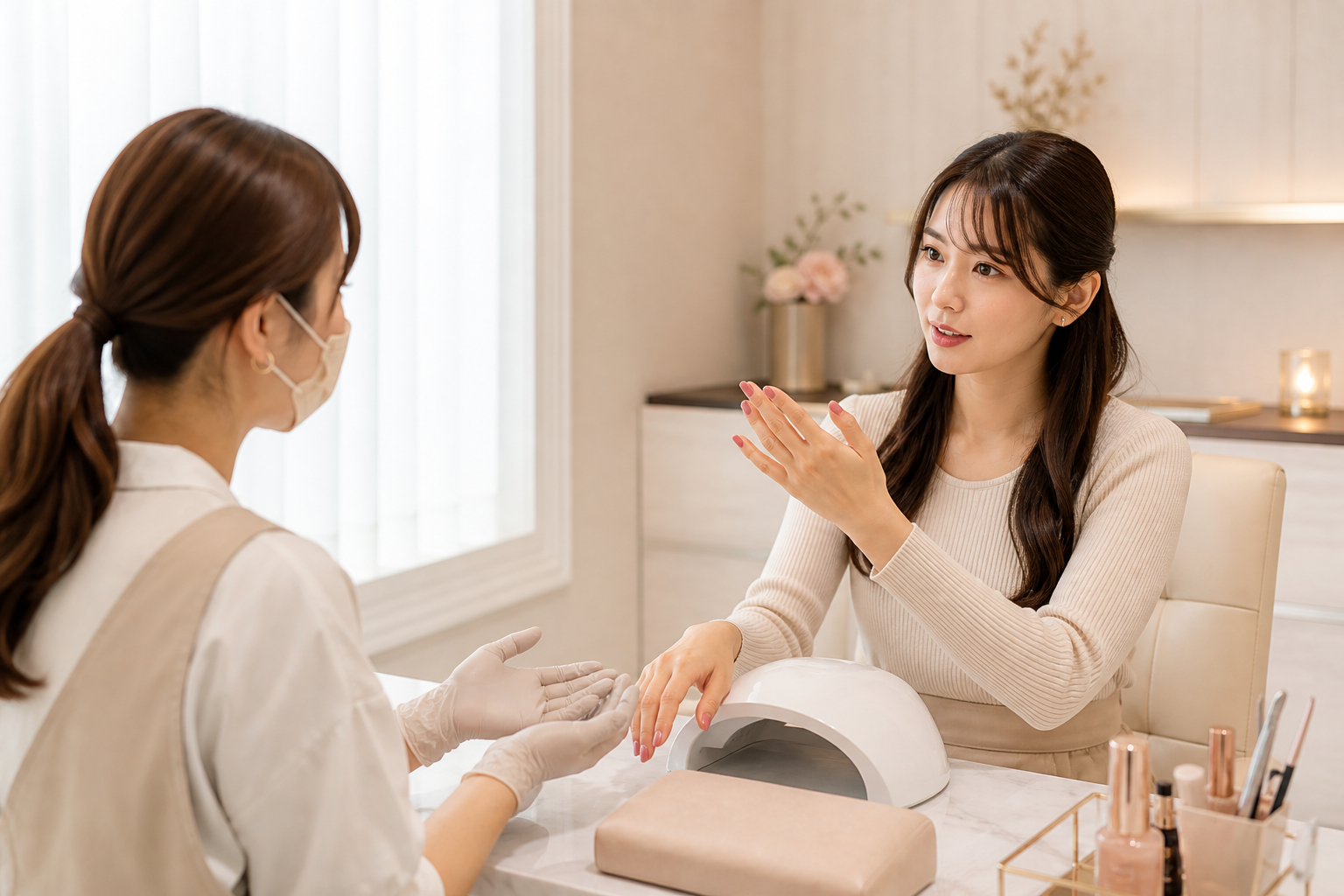
In open-plan salons, the noise and proximity to other clients can make communication awkward — especially when you’re trying to explain a complex request in a second language. Private rooms allow for a calmer, more focused consultation where you can take your time showing references, asking questions, and making sure you’re both on the same page.
Transparent Pricing
Nail pricing in Japan can be surprisingly opaque for newcomers. Base price, design fee, length surcharge, removal fee, material upgrade cost — these can stack up. A foreigner-friendly salon should give you a clear price estimate before they start, not surprise you at checkout.
When visiting any nail salon in Japan for the first time, always bring 3–5 reference photos that show: (1) the shape you want, (2) the length you want, and (3) the design style. Even if language is limited, photos eliminate ambiguity. The best technicians will look at your references, check your natural nails, and give you honest advice about what’s achievable in one session.
The Science of Nail Longevity: Why Some Nails Last 8 Weeks and Others Lift in 10 Days
One of the most common complaints from foreigners who’ve had nails done in Tokyo is early lifting. You spend ¥15,000–¥20,000 on a full set, and within two weeks there are gaps forming between the enhancement and your natural nail.
This isn’t bad luck. It’s almost always the result of one or more of the following technical factors:
Preparation (Prep) Quality Is Everything
The single biggest factor in nail longevity isn’t the brand of gel or the type of tip — it’s preparation. Prep involves:
- Cuticle work: Removing dead skin and pterygium (the thin membrane that grows onto the nail plate) from the nail surface
- Surface dehydration: Removing moisture and natural oils from the nail plate so the gel/tip adhesive bonds properly
- Light filing: Creating micro-texture on the natural nail for better adhesion
- Application of pH bond and primer: Chemical pre-treatment that further improves adhesion
A rushed prep — which is common in high-volume salons running on tight time slots — leads to poor adhesion. The enhancement looks fine for a week, then starts lifting at the edges as the bond weakens.
Product Compatibility
Not all gel systems are designed to work together. Using a base coat from one brand with a color gel from another and a top coat from a third is a recipe for delamination. Professional salons maintain consistent product systems — they don’t cut corners by mixing incompatible products just because they’re cheaper.
Nail Thickness and Natural Flexibility
Here’s something most articles don’t mention: the natural flexibility of your nail plate directly affects how long your enhancement lasts. If you have naturally thin, bendy nails, a rigid gel or acrylic overlay may crack or lift faster because it can’t flex with your nail. Chip sculpt with a hard gel coating is particularly good for thin nails because the tip provides structural support before the gel is applied, distributing stress more evenly.
Aftercare Behavior in the First 48 Hours
The first 48 hours after a full sculpt set are critical. The gel has cured under a lamp, but the adhesive between the tip and the natural nail needs time to fully stabilize. During this window:
- Avoid prolonged water exposure (long baths, hot springs)
- Don’t use your nails as tools (opening cans, scraping labels)
- Avoid direct heat on the nail surface
Thorough prep + compatible products + correct technique for nail type + proper aftercare = long-lasting nails.
Skip any one of these, and you’re rolling the dice.
Understanding Gyaru Nails and Dramatic Japanese Nail Art: A Guide for Foreigners
If you’ve been drawn to the kind of nails you see on Japanese fashion magazines, egg model accounts, or certain corners of TikTok and Instagram, you may have encountered gyaru nail culture without knowing it by name.
What Are Gyaru Nails?
Gyaru (ギャル) is a Japanese fashion subculture that emerged in the 1990s and has gone through multiple revivals. The aesthetic centers on bold, maximalist femininity: tanned skin, large eyes, layered fashion, and — critically — elaborate nails.
Gyaru nails typically feature:
- Length: medium-long to very long
- Shapes: square, coffin (ballerina), stiletto, or almond
- Decoration: rhinestones, pearls, 3D flowers, gold/chrome accents, hand-painted art
- Color palette: warm tones, pastels, bold metallics, or high-contrast combinations
- Finish: often combines matte and gloss in the same set
Why Most Salons Refuse Gyaru Nails
Executing a true gyaru nail set requires significant time and a specific skill set. A single set with hand-painted art, multiple 3D elements, and complex color blending can take 3–5 hours. Most high-volume salons can’t accommodate this without scheduling issues — and many simply don’t have technicians trained in it.
This is why gyaru nail salons in Tokyo occupy a distinct niche: they’re specialists, not generalists.
Other Dramatic Design Categories You Should Know
3D Nails (3Dネイル): Sculptural elements built up from acrylic or hard gel — flowers, ribbons, geometric shapes — that actually protrude from the nail surface.
Ita-Nails / Otaku Nails (痛ネイル): Nails featuring anime characters, game artwork, or fandom references — usually requiring hand-painting or custom nail art transfers.
Super Long Nails (スーパーロング): Extensions that go beyond typical “long” nails into dramatic fashion statement territory — 2cm+ past the fingertip.
Chrome / Mirror Nails: An ultra-high-shine powder finish that creates a metallic mirror effect. Looks stunning but requires specific application technique to achieve correctly.
Not all salons that advertise “3D nails” can actually execute complex 3D art. The term is used loosely. Before booking, ask specifically: “Can I see examples of 3D work your technicians have done?” Any legitimate specialist will have a portfolio — either physically at the salon or on their Instagram/LINE account.
Paraquel (Parajel) Nails: What Is It and Why Does It Matter?
If you’ve done any research on nail salons in Japan, you’ve likely come across the term “Parajel” (パラジェル). Here’s what it actually means and why it’s relevant to you.
The Problem with Standard Gel Removal
Traditional gel nails are removed by filing down the top surface, then wrapping the nails in acetone-soaked cotton for 10–15 minutes to dissolve the remaining gel. Done correctly, this is safe. Done incorrectly — or done repeatedly over time — it can cause nail thinning, dehydration, and surface damage.
What Parajel Is
Parajel is a specific brand of gel nail product (developed in Japan) that is formulated to be applied without the aggressive pre-filing that standard gel requires. Because it bonds differently to the nail surface, it can be removed without filing the natural nail — just a gentle soak-off. This makes it significantly gentler on the nail plate over repeated use.
Why “Parajel Upgrade Free” Is a Big Deal
At most salons in Japan, switching from standard gel to Parajel costs an extra ¥1,000–¥2,000 per visit. Over the course of a year of regular appointments, that adds up. Salons that offer Parajel as a free standard option are making a deliberate choice to prioritize nail health over cost-cutting — which says something about their overall philosophy.
💅 At BARON, Parajel is included at no extra charge.
We believe healthy nails are the foundation of beautiful nails. By using Parajel as standard, we protect your natural nail plate across every visit — so your nails look better and last longer over time, not just for one set.
How to Book a Nail Salon in Shinjuku as a Foreigner: Step-by-Step
Navigating the Japanese booking system can be confusing if you’ve never done it before. Here’s a clear walkthrough.
Option 1: Hot Pepper Beauty (HPB)
HotPepper Beauty is Japan’s largest beauty booking platform. Most nail salons list on it. The platform is in Japanese, but it allows you to see photos, prices, and book online.
Useful tip: Use Google Translate’s camera feature to scan the Japanese text, or use the English version of the site if available for the salon you’re considering.
Option 2: Direct Booking via LINE or Instagram
Many salons in Tokyo now accept bookings via LINE (Japan’s dominant messaging app) or through Instagram DM. This is often the friendliest option for foreigners because:
- You can send design photos directly in the chat
- You can communicate asynchronously (no language pressure in real time)
- The salon can review your request before confirming, preventing misunderstandings
Option 3: English-Language Salon Websites
A small number of salons in Tokyo, particularly those in areas with high foreign visitor traffic like Shinjuku and Shibuya, now maintain English-language websites or booking pages. These are the most straightforward option and are worth seeking out.
What to Include in Your Booking Request
Whether booking online or by message, include:
- Your desired nail length and shape
- Your design idea (with a reference photo if possible)
- Whether you want extensions (sculpt) or just gel on natural length
- Whether you have any existing nails that need removal
- Any nail health concerns (thin nails, damaged nails, previous lifting issues)
This gives the salon everything they need to assign the right technician, allocate the right time slot, and give you an accurate price estimate before you arrive.
The 5 Biggest Mistakes Foreigners Make When Getting Nails Done in Japan
Mistake 1: Booking Based on Price Alone
Japan has nail salons at every price point. The ¥5,000 coupon deal looks tempting — but what it usually means is a 60-minute slot, standard gel only, and a technician working too fast to do quality prep. For simple, short nails, budget salons can be fine. For sculpt work or complex designs, you get what you pay for.
Mistake 2: Not Removing Existing Enhancements Before Your Appointment
If you arrive with existing gel, acrylic, or nail tips from another salon, removal will be added to your session time and cost. Worse, if the previous salon used hard acrylic and the new salon has to file it off aggressively, your natural nails may be compromised before the new set even begins. Always mention existing enhancements when booking.
Mistake 3: Showing Only One Reference Photo
A single reference photo gives your technician one data point. Show three to five photos from different angles, or showing slightly different variations of what you want. This gives them a clearer picture of your aesthetic direction and makes it less likely that a misinterpretation leads to a disappointing result.
Mistake 4: Ignoring Aftercare Instructions
Japanese nail technicians will typically explain aftercare at the end of your appointment. If you don’t understand the language, ask them to write it down or show you on their phone. The most important rules — avoid prolonged soaking, apply nail oil daily, don’t use nails as tools — are universal regardless of language.
If you notice green discoloration under a nail enhancement, do not try to fix it yourself or cover it with nail polish. This is a sign of bacterial growth (Green Nail Syndrome / グリーンネイル) caused by moisture trapped under a lifted enhancement. Remove the enhancement immediately and let the nail air dry for 1–2 weeks before rebooking.
Mistake 5: Assuming “Long Nails” and “Sculpt Nails” Are the Same Request
Some salons can do moderate nail extensions using just gel — building up the free edge slightly with builder gel or extending with gel tips. This looks like sculpt nails but doesn’t have the same structural strength and won’t last as long. If you want true length and structure, be explicit: ask for “sculpt nails” (スカルプネイル) or “chip sculpt” (チップスカルプ).
Nail Care for Different Lifestyles: Advice for Your Situation
For People Who Work With Their Hands (Medical, Kitchen, Manual Work)
Frequent hand-washing and glove use create a tough environment for nail enhancements. Chip sculpt with hard gel top coat is more resistant to the cycle of wet-dry-wet than standard gel, but even the best set will need more frequent touch-ups. Plan for 3–4 week fill-in appointments rather than pushing to the maximum longevity window.
For People With Thin or Damaged Natural Nails
If your natural nails are thin, peeling, or recently damaged, jumping straight into heavy sculpt work can cause further damage. Ask your technician to assess your nail health first. In many cases, a strengthening gel treatment for a few weeks before a full sculpt set is the smarter approach — it gives your natural nail the structure to support the enhancement properly.
For First-Timers Getting Sculpt Nails
Your first sculpt set will feel different from standard gel. The nails will be heavier and more rigid. Your fingertip sensitivity will change. Give yourself a week to adjust before deciding you don’t like the length. Most first-timers who request their sculpts removed in the first week end up regretting it once they’ve adapted.
For Frequent Travelers
If you travel frequently, prioritize chip sculpt or well-applied hard gel — they handle the climate changes (humidity, dry airplane air, temperature shifts) better than softer gel systems. Apply nail oil every day, not just occasionally, to keep the nail bed hydrated despite environmental changes.
For Anyone Who Loves Dramatic, Long Nails Regularly
If you’re planning to maintain long sculpted nails long-term (more than 3 months), build in regular fill-in appointments rather than full removal and re-application each time. Fill-ins preserve more of your natural nail, cost less, and keep the nails looking fresh without the stress of repeated full-set applications.
Frequently Asked Questions About Nail Salons in Shinjuku for Foreigners
Q. Do nail salons in Shinjuku speak English?
A. Most salons in Shinjuku do not have fully English-speaking staff. However, a growing number — particularly those catering to tourists and expats — maintain English-language websites, English menus, and staff who can communicate basic nail requests in English. Booking in advance with a written request and reference photos is the best approach regardless of language ability.
Q. How much does a sculpt nail set cost in Shinjuku?
A. A full chip sculpt or acrylic sculpt set in Shinjuku typically ranges from ¥12,000 to ¥25,000+ depending on length, complexity of design, and salon tier. Factor in removal of existing nails if applicable, and budget for a tip if you’re satisfied with the service — tipping is not customary in Japan, but a simple thank-you in Japanese (ありがとうございました) is always appreciated.
Q. What is chip sculpt, and is it better than acrylic for foreigners?
A. Chip sculpt uses a pre-formed nail tip bonded to the natural nail, then coated with hard gel for structure. It has no acrylic smell, produces a smoother finish, and is generally gentler on the natural nail. For most foreigners seeking long, dramatic nails without the acrylic salon environment, chip sculpt is an excellent choice. Acrylic sculpt remains better for maximum structural strength.
Q. How long do sculpt nails last?
A. With proper preparation and aftercare, chip sculpt nails can last up to 8 weeks. However, for the best appearance and nail health, a fill-in or refresh appointment at 3–4 weeks is often recommended. After 4 weeks, natural nail growth creates a visible gap at the cuticle area that many clients prefer to address sooner.
Q. Can I get anime or otaku-themed nail art in Shinjuku?
A. Yes — but only at specialist salons. Anime/otaku nail art (痛ネイル, “ita-nails”) requires hand-painting skills and significant session time. Most mainstream salons do not offer it. Look specifically for salons that advertise ita-nails or show examples in their portfolio before booking.
Q. Is Parajel worth the upgrade fee at Japanese nail salons?
A. If you get nails done regularly (every 3–6 weeks), yes — Parajel significantly reduces the cumulative damage to your natural nails over time. If you’re only getting nails done once while visiting Japan, standard gel is fine. The biggest benefit of Parajel is long-term nail health for regular clients.
Q. How do I remove gel or sculpt nails safely if I’m back home and can’t get to a salon?
A. For gel nails: file the shiny top coat, soak cotton pads in acetone, wrap each fingertip in foil for 10–15 minutes, then gently push off the softened gel with a cuticle pusher. Never force or peel gel off — this tears the surface layer of your natural nail. For sculpt nails: do not attempt home removal. Go to a professional. Improper removal of hard gel or acrylic can cause serious nail damage.
Q. Do Japanese nail salons accommodate people with very short or bitten nails?
A. Yes — this is actually one of the best use cases for sculpt techniques. Chip sculpt and acrylic sculpt can create length and shape on nails that are too short for standard gel extensions. A good technician will assess whether your natural nail is healthy enough to support the enhancement and advise accordingly.
Q. What should I do if my sculpt nails start lifting?
A. Do not ignore lifting. Moisture can get trapped in the gap between the enhancement and the natural nail, creating conditions for bacterial growth (Green Nail). Book a fill-in appointment as soon as you notice lifting — most salons can repair a lifted nail without removing the entire set. In the meantime, keep the area dry and apply a small amount of nail glue only if the lift is minor and you’ve confirmed there’s no discoloration underneath.
Q. Is it OK to go to a hot spring (onsen) with sculpt nails?
A. One visit is generally fine if your nails are well-adhered. Extended soaking (30+ minutes in very hot water) can soften the adhesive bond over time. If you’re planning multiple onsen visits, tell your technician before your appointment — they can recommend preparation steps that improve water resistance.
Q. How far in advance should I book a nail appointment in Shinjuku?
A. For a simple gel manicure, 2–3 days in advance is usually sufficient. For a complex sculpt set or dramatic design, 1–2 weeks in advance is safer — specialist technicians have limited slots and complex sessions require longer appointment blocks. If you’re visiting Tokyo with a specific nail appointment in mind, book before you arrive.
Q. Can foreigners use HotPepper Beauty to book nail salons in Japan?
A. Yes — HotPepper Beauty accepts bookings without a Japanese phone number (you can register with an email address). The site is in Japanese, but Google Translate makes it usable. Alternatively, look for salons with English-language websites that allow direct booking — this eliminates translation friction entirely.
Summary: What to Look for in a Nail Salon in Shinjuku as a Foreigner
Here’s what this guide comes down to:
- Find a salon that specializes in sculpt nails, not just gel — especially if you want length, structure, or 3D art
- Prioritize salons with genuine communication capability in English (website, DM, or in-person)
- Look for private rooms for a better consultation experience
- Understand the difference between chip sculpt, acrylic sculpt, and gel so you can ask for what you actually want
- Book in advance, send reference photos, and be specific about length, shape, and design
- Don’t ignore aftercare — it’s the difference between nails that last 2 weeks and nails that last 8 weeks
If you’re looking for a salon in Shinjuku that handles all of this — sculpt expertise, dramatic designs, English-friendly booking, private rooms, and technicians trained specifically in gyaru and over-the-top nail art — BARON is worth checking out.
💅 Nail Salon BARON
Sculpt Specialists × Gyaru Nail Experts
Private Rooms|Parajel Free Upgrade|Up to 8 Weeks Wear
Dramatic Designs Welcome — We Take On What Other Salons Refuse
📸 @nail_baron_japan on Instagram
📍 Locations